

Rather listen? Simply hit the play button and listen to the article in full
Barrie Clement considers the pros and cons of driving as an older person
If you have a frail, elderly parent who insists on continuing to drive, you may be forgiven for being concerned about their safety – and for the safety of pedestrians and other road users.
On the other hand, dear reader, you may be of a certain age yourself and seeking to maintain your independence.
For the moment, there is no upper age limit for driving in the UK, or compulsory tests for those of us who are getting on a bit (I’m 77). I say ‘for the moment’ as some people think the current state of affairs is positively dangerous.
The RAC Foundation reports there are 5.97 million full licence holders aged 70 or older in Great Britain. This includes 510 individuals aged 100 or more, the oldest reportedly being a 110-year-old woman.
Although licences expire at 70, they can be renewed every three years by ‘self-certifying’ you are fit to drive. The renewal form asks about your health, medication and whether you’ve had any recent accidents. Some of us may be tempted to adopt a Trumpesque approach to the truth, or at least to ‘misinterpret’ the questions. More seriously, people with dementia may be unaware of their condition and/or their limited driving ability. So how can older motorists, or anyone else for that matter, be stopped from driving?
There are court-imposed bans for dangerous driving and persistent offences (12 or more penalty points within three years). But, the argument goes, many more people continue to drive with worsening eyesight – especially at night and in the rain – or with spatial awareness and hand-eye co-ordination no longer up to the task.
Father-daughter concerns
One person who’s deeply concerned about the safety of a parent is CSPA General Secretary Sally Tsoukaris. Although her father lives in South Africa, her anxiety will be familiar to many in the UK. Sally’s father is 97 and “still determinedly driving”. She says: “My brother and I are scratching our heads – he may have an accident and harm himself or others.
“With the benefit of modern laser technology, his eyesight remains relatively good and his GP does little more than ‘tut’ a bit and ask him if he thinks he should be driving at his age – to which his unhesitating response is yes!
“Dad has always been a very keen, safe and excellent driver. During his long engineering career, and throughout my childhood, he drove literally hundreds and hundreds of thousands of miles across Africa and Europe, all very safely.
“Dad currently lives on his own, in a friendly retirement community about half an hour’s drive from Cape Town. He has stopped using the dangerous motorways in recent years, thank goodness, but his independence and autonomy are supported in no small part by being able to nip to the shops, go to church or attend local events in the car.
“He frequently offers lifts to his friends and neighbours as well, being an active member of his community, which helps maintain his interest in others, a social calendar and a general sense of purpose.
“How and when do we, as his loved ones, intervene to take this away from him if he fails to take such a decision, in good time, by himself?
“We have always skirted around the issue when talking to him directly. My brother and I live much too far away from him to be of any help in driving him to medical appointments and the like, so he would be forced to rely on the kindness of friends or use the somewhat irregular community bus or local taxis.
“So here we are – unless we are forced to intervene, or he decides to relinquish his beloved car himself, or (heaven forbid) something drastic happens… Dad has just recently renewed his licence for another three years.”
Driving safety in focus
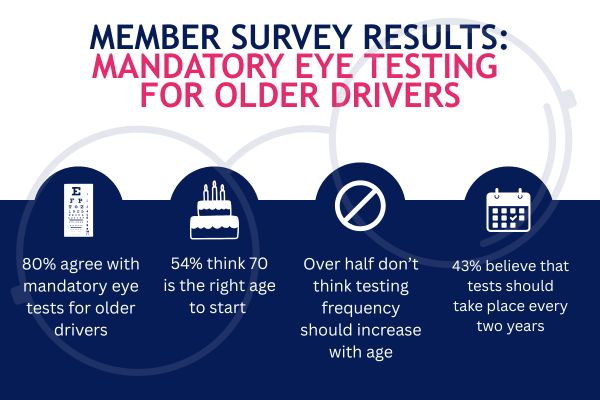
We invited members to share their views on the possible introduction of mandatory eye tests for older drivers. The message was clear: over 80% of respondents support mandatory eye tests for older drivers.
Ways to intervene
So clearly there are people who have legitimate concerns about their loved ones. Apart from asking them to give up motoring, there are ways in the UK of forcing them to do so.
If you feel someone is not fit to drive and they refuse to stop, you can report your concerns in confidence via the DVLA helpline – 0844 453 0118 – or the complaints team at DVLA, Swansea SA6 7JL. The DVLA may contact the police or insist on medical assessments and can revoke a driver’s licence if they are deemed medically unfit to drive.
But are older drivers more prone to accidents and driving offences than younger ones? The evidence is equivocal. According to the insurance industry, which clearly has a financial interest in knowing what’s what, there are essentially two peaks.
The Association of British Insurers reports that the value of individual claims is at its highest after the age of 66, although the figure starts coming down for those aged 91 plus. And the total number of insurance claims is at its highest between the ages of 18 and 25, and gradually comes down thereafter.
Research funded by the RAC Foundation estimates that one motorist in 10 aged 70-plus is not fit to drive and should give up their car.
The investigation, carried out by the Transport Research Laboratory for the foundation, was sparked by a spate of crashes involving elderly motorists, prompting calls for a more thorough assessment of older licence holders’ driving ability.
On the other hand, police data collated by the government-funded Older Drivers Task Force suggests that elderly motorists are less likely to be involved in crashes than young ones.
The problem for us older drivers is that we are more fragile and four times more likely to die or be seriously injured. Deaths through road accidents among the 70-79 age group is forecast to surge by 40 per cent over the next 20 years due to the country’s ageing population.
A report by the Older Drivers Task Force, Supporting safe driving into old age, points out that older drivers have reduced ability to judge and adapt their speed and read complex driving situations. Vision, reaction times and manoeuvring skills decline with age, it says.
However, as drivers age, self-regulation is common. Older drivers make fewer journeys and avoid demanding situations such as motorways, driving at night, in peak periods and at difficult junctions. And I would add that, despite the anger it elicits from younger drivers, most older motorists drive at slower speeds.
Fitness to drive
The task force says assessments of driving skills should be offered to all motorists aged 70 and above who have committed offences – instead of facing legal penalties. ‘Fitness to drive’ evaluations, during which abilities are assessed by qualified occupational therapists and driving instructors, are currently only run by a few police forces.
If any driver is found to be unfit to be behind the wheel, the DVLA is notified and considers whether to remove their licence. In some instances, drivers are referred for more lessons and offered a reassessment within three months.
Those offered an assessment as a first response to careless driving or driving without due care and attention would then avoid the usual £100 fine and three penalty points.
According to the task force, rolling out fitness-to-drive assessments nationally would help to reduce deaths and serious injuries among older drivers.
RAC Foundation director Steve Gooding comments: “Allowing older drivers to remain mobile is critical to their mental and physical wellbeing, but so is safety. A system that helps people address their shortcomings rather than simply penalising them could help maintain this balance.”
Advanced driver-assistance systems – technologies that enhance safety while driving – can help. They use sensors, cameras and software to monitor the vehicle’s surroundings, provide assistance and warnings, and even take corrective action. Much of the technology is available in new cars, but the degree of sophistication and efficiency depends on price and model.
At some stage, there will be widespread use of completely driverless vehicles. As you read this, however, that still seems to be some way off.