
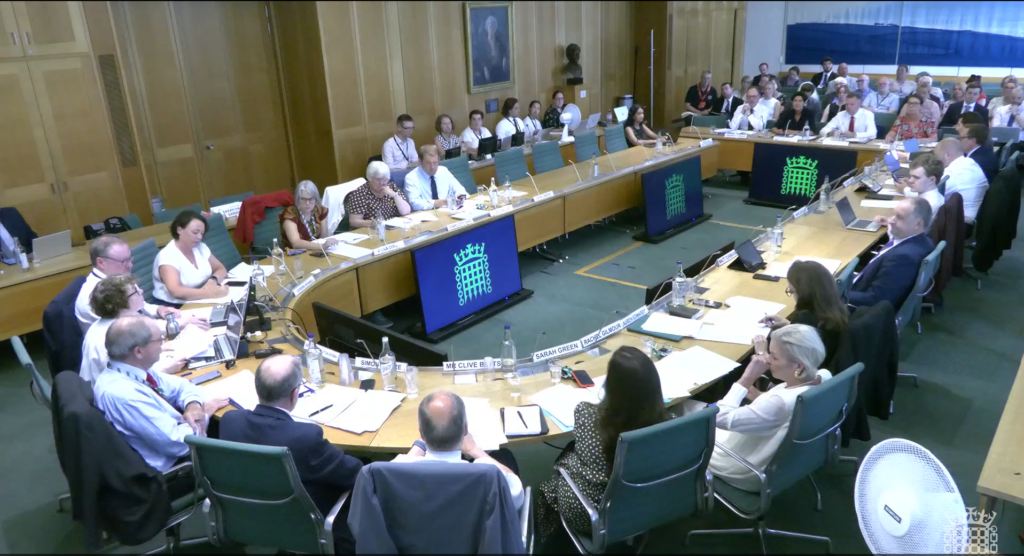
The administration of the Civil Service Pension Scheme came under intense scrutiny on 8 July as the Public Accounts Committee (PAC) and the Public Administration and Constitutional Affairs Committee (PACAC) held a joint evidence session examining ongoing failures by Capita to deliver an acceptable service for scheme members.
The session, which lasted almost four hours, focused on the growing backlog of pension cases, delays affecting those coming up to retirement and bereaved families, the Cabinet Office’s response to the crisis, and whether the administration of the scheme should ultimately be brought back in-house.
The full session can be viewed here: Parliamentlive.tv – Public Accounts Committee and Public Administration and Constitutional Affairs Committee
CSPA Raises Members’ Concerns with Parliamentarians
Ahead of the hearing, CSPA wrote to PAC Chair Sir Geoffrey Clifton-Brown MP and PACAC Chair Simon Hoare MP to highlight the continuing difficulties experienced by members.
The day before the evidence session, CSPA met with Sir Geoffrey Clifton-Brown MP and Clive Betts MP, Deputy Chair of the Public Accounts Committee. The meeting provided an opportunity to discuss individual member cases alongside wider concerns about the administration of the Civil Service Pension Scheme.
During these discussions, CSPA outlined the significant impact that delays and service failures continue to have on scheme members, prospective retirees and bereaved families. We emphasised the need for urgent improvements and stronger accountability to restore confidence in the scheme.
Notably, examples of CSPA member cases were raised during the committee hearing itself. Clive Betts MP highlighted these concerns directly with the Paymaster General and Minister for the Cabinet Office, Rt Hon Nick Thomas-Symonds MP, who requested that the details of the cases be passed on to him personally.
Backlog Remains at Concerning Levels
A central theme throughout the hearing was the sheer scale of outstanding work within the pension administration service.
Rt Hon Nick Thomas-Symonds MP confirmed that service levels had not returned to normal by the end of June and that significant backlogs remain across multiple areas of the scheme. Committee members heard that there are:
- More than 6,700 outstanding pension quotations relating to past retirement dates.
- More than 4,100 unresolved bereavement cases.
- Approximately 111,700 outstanding pieces of work, compared with a typical operating level of around 55,000.
- 3,127 delayed pension payments, including 1,800 delayed by more than 30 days.
- 16,876 bereavement cases awaiting action.
- 618 death-in-service cases and 429 ill-health retirement cases awaiting processing.
Officials also revealed that around 377,000 items of work have accumulated since Capita took responsibility for the contract, including approximately 90,000 inherited cases.
Committee members from across the political spectrum expressed deep concern about the impact these delays are having on scheme members, particularly those approaching retirement and families dealing with bereavement.
Cabinet Office Intervention Continues
The Cabinet Office outlined the steps taken since intervening in late January to stabilise the service.
Measures introduced include the establishment of a dedicated recovery Taskforce and the deployment of an additional 140 staff to assist with processing work and reducing delays.
While it was stated that some improvements had been achieved, including reduced telephone waiting times and better operational performance in certain areas, they acknowledged that the current level of service remains unacceptable.
Capita has been placed into contractual default and is expected to fail 16 of its 21 key performance indicators (KPIs). The Cabinet Office has already withheld £9.9 million in transitional payments, with further contractual penalties remaining under consideration.
Technology Failures Under the Spotlight
A significant portion of the evidence session focused on the technology and automation systems promised by Capita during the procurement process.
Cabinet Office officials told MPs that assurances had been given that the necessary systems would be in place and operating effectively. However, substantial technology and data problems emerged following the transition to Capita’s administration model.
These issues are now widely regarded as a major contributor to the backlogs and operational failures that have affected scheme members.
In response, independent auditors and specialist remedial advisers have been appointed to examine Capita’s recovery plans, technology systems, data management and operational processes.
Committee members questioned how such significant risks were not identified earlier and whether sufficient due diligence had been carried out before the transition was approved.
Capita Apologises and Sets Out Recovery Plan
Representatives from Capita apologised for the disruption caused to pension scheme members and their families.
The company attributed its difficulties to a combination of factors, including the complexity of the scheme, problems with historical data quality and technology challenges encountered during implementation.
Capita stated that it has increased staffing and processing capacity and expects to clear the majority of retirement-related backlogs by 1 September. However, it acknowledged that around 600 highly complex cases may take longer to resolve.
The company also indicated that it expects to return to normal service level performance by 30 September, although MPs sought assurances that these targets would be met given previous failures.
Growing Interest in Bringing the Service Back In-House
One of the most significant discussions during the hearing concerned the future delivery model for Civil Service pensions administration.
Ministers confirmed that all options remain under consideration, including bringing the service back into government control once the current contract arrangements are reviewed.
While no decision has been taken, the Government described the contract as a strong candidate for future insourcing. Ministers emphasised, however, that any such move would require government to build and maintain the capability needed to administer a pension scheme serving approximately 1.7 million members.
The prospect of insourcing attracted considerable interest from members of both Committees, reflecting broader questions about the effectiveness of outsourcing complex public services.
Confidence Must Be Rebuilt
The joint PAC and PACAC session demonstrated strong cross-party frustration with the ongoing shortcomings in the administration of the Civil Service Pension Scheme.
While both the Cabinet Office and Capita presented plans intended to improve performance and reduce the backlog, Committee members made clear that confidence will only be restored when scheme members see tangible improvements in service delivery.
For CSPA, the hearing was an important opportunity to ensure that members’ experiences were heard directly by parliamentarians. We will continue to monitor developments closely, press for accountability and advocate for the timely resolution of the issues affecting members and their families.
The coming months will be crucial in determining whether Capita can meet its latest recovery milestones or whether more fundamental changes to the administration of the Civil Service Pension Scheme are required.